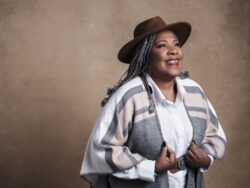
About our guest author: Melody Starya Mobley’s experiences as the first black woman serving as a forester for the USDA are remarkable: both for the firsts she embodies and for the years of abuse and oppression she experienced within that system.
Now, Melody shares her personal stories to create positive change for groups historically excluded from accessing American natural spaces.
With the few federal protections that exist currently being stripped away, it’s more important than ever for stories like these to be told. Learn more about Melody and watch her documentary The Dark White Forest on her website at starya.org.
Image credit: Kirth Bobb
Feeling academically invisible
My undergraduate schooling happened in stages. Not because I couldn’t make up my mind or because I had to leave and come back—it took me a few tries to find any kind of support system for Black students.
First, I attended university from 1975 to 1977 at the University of Louisville (U of L) in Kentucky. One of the main reasons I left the U of L was that my grades were dropping precipitously: I wasn’t focusing on my studies even though I was studying zoology, my first love. At the U of L, I was invisible, just one of relative hordes of Black women studying zoology to get into medical school.
No one at the university asked me why my grades were dropping. No one asked me if things were okay at home. No one offered to mentor me, and I didn’t know to ask. I was staying out late at night and drinking alcohol even though I was underage. I had to remove myself from this environment or else ruin my life.
What academic support can look like
I transferred to the University of Washington (UW) in Seattle. I had a fascination with deceased martial artist Bruce Lee, and Lee had taught Jeet Kune Do there. I found a martial artist to study with, who had learned directly from Lee. It was as simple as that. I also wanted to study wildlife biology instead of zoology. It took me away from competing with potential medical students, and I hoped it would lead me to a career in field research, zoo work, or something else that was directly related to animals. I finished my Bachelor of Science at UW in 1979.
My second undergraduate school had a department that was directly concerned with supporting Black students. It wasn’t the typical Black Student Union; it was more.
- They were the first people to meet with new Black students in underrepresented fields of study.
- They noticed when my grade point average dropped and called me in to try to figure out why.
- They supported my social life and made sure I wasn’t isolated—something my College of Forest Resources (CFR) should have done but didn’t. The support system was better than the nothing at U of L, even if I was still isolated in classes and extracurricular activities.
More can be done to support academic futures
I switched my major from wildlife biology to forest management because the USDA Forest Service offered me a full-time job contingent upon changing my major, and I needed one of the sparse permanent jobs. As it turned out, I was the first African American woman to graduate from the UW with a degree in forest management.
At the CFR I was isolated and unpopular. I called fewer than a handful of students “friend” and I was rarely invited to social events. I did have a wonderful mentor by that time, Dr. Kristiina Vogt. But knowing I was in a unique position at the CFR and the UW—a virtual history-maker—you’d think they would have offered me some level of support, including applying some of these strategies for supporting people of color in academic and professional settings. (They didn’t.)
To this day, people of color are underrepresented in most natural resource-related areas of study. We’ve got to change that because we need the best and brightest students of all races and ethnicities to help solve the very challenging issues we face today. It’ll take all of us.
“We need the best and brightest students of all races and ethnicities to help solve the very challenging issues we face today.” — Melody Starya Mobley

Read more of Melody’s writings
on the American Green blog.