
What is FSC-STD-20-011?
FSC-STD-20-011 is the Forest Stewardship Council® (FSC) Chain of Custody (CoC) Evaluations.
This standard provides the requirements to be followed by FSC-accredited certification bodies (CBs) when auditing CoC organizations. FSC-SD-20-011 aims to reduce the level of subjectivity and increase the consistency between sampling levels implemented by different CBs across different situations.
Why are there proposed revisions?
At the 2025 FSC General Assembly, FSC presented the upcoming revision of its CoC standard, which outlines key changes to strengthen credibility, improve usability, and streamline multiple related standards into a single framework.
Proposed revisions & Chris’ comments
All FSC members and stakeholders are invited to review and provide feedback on the proposed revisions via the FSC Consultation Platform between now and January 25, 2026.
We know reviewing these revisions can take time—perhaps more time than is available. With that in mind, American Green president Chris Gibbons has reviewed the proposed revisions in full and provided his comments below. Our hope is that this will provide additional background and rationale so that your own revision process is easier.
We’ve provided screenshots below of each section of the proposed revisions to FSC-STD-20-011. You can also download the entire PDF here, which also includes revisions for FSC-STD-40-004.
Section 1
No major change in this section except the incorporation of INT-STD-20-011_12 (verification of commitment to the Policy for Association) in Clause 1 e).
Sections 2-5
No changes in these sections.
Section 6
Background & questions

Chris’ comments
- Q1a – Neutral
- Q1b – 6.1.c should be reworded for clarity. It is an awkward sentence as written.
Section 7
Background & questions

Chris’ comments
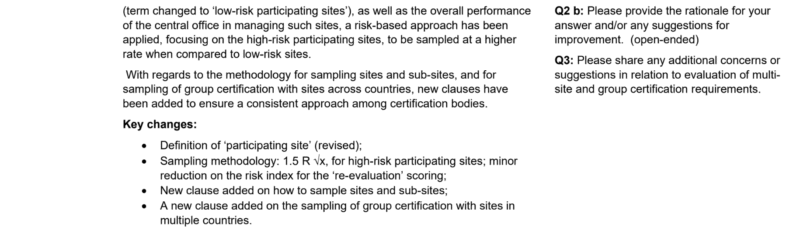
- Q2a – Agree
- Q2b – No response
- Q3 – It is unclear how certification bodies are defining low-risk vs. high-risk participating sites. Some clarity around that topic should be added.
Sections 8 & 9
No changes or major changes in these sections.
Sections 10 & 11
No major changes in these sections. Terminology aligned with FSC-PRO-60-006b.
Section 12
Background & questions
Chris’ comments
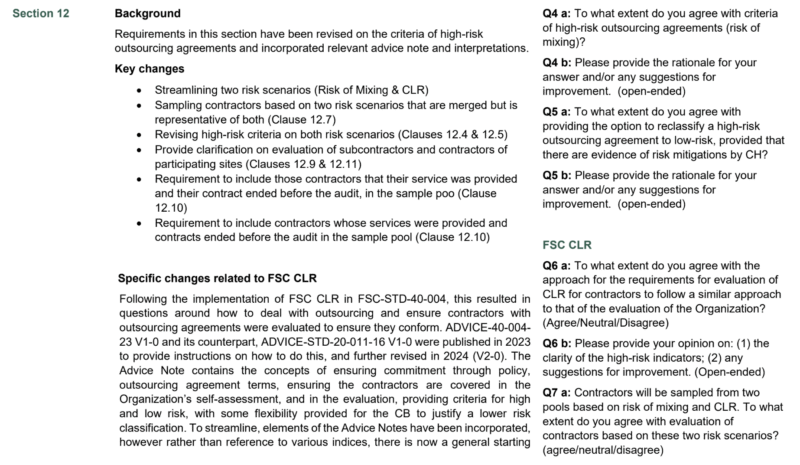
- Q4a – Neutral
- Q4b – No response
- Q5a – Agree
- Q5b:
- Note 1 – An example of risk mitigation would be beneficial.
- Note 2 – Does this mean that they are exempt from CLR as well? If not, that is not clear.
- Q6a – Disagree
- Q6b:
- 12.5.2.a is telling us that if your contractor has been audited within the past five years, they are no longer high risk? Why would that make a difference to high risk? If they are high risk, they are high risk. They should still be in the high risk category, but other high risk outsourcers who haven’t been visited yet should be prioritized for visits.
- 12.5.2 NOTE – there is no reason to have a 15 month cut off on this. It adds nothing and creates unnecessary NCRs for pointless reasons. Just stick with annual. If someone runs out to 23 months, that’s not the end of the world.
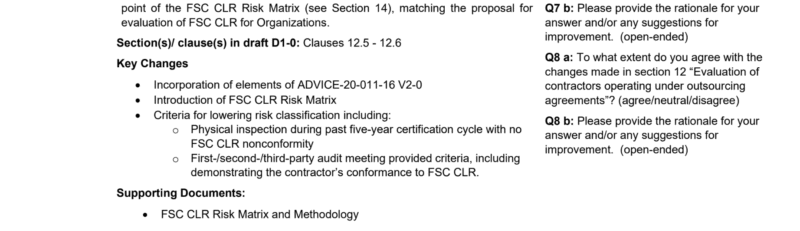
- Q7a – Agree.
- Q7b – Though I have concerns about the legality in certain countries about enforcing labor laws on outsourcers, I do see the institutional risk to FSC of allowing someone to avoid core labor requirements simply by sending the work outside of the certified company. There is no simple answer here. I am in support of the lightest touch possible to attain that goal.
- Q8a – Neutral
- Q8b – 12.9 – In practical application, most companies have 1-3 outsourcers that may fall under high risk. Which means that all, or almost all, of the outsourcers are going to be visited under the formula in 12.8. For group and multisite certification, assessing at the certificate level instead of the participating site level, means that an actual sampling ratio has a chance of being applied. Especially for group certifications, changing this will be a significant benefit to small businesses, which is something that FSC continuously talks about supporting but historically has failed to do. I strongly suggest changing 12.9 to assess sampling at the certificate level rather than the participating site level.
Section 13
No major changes in this section.
Section 14
Background & questions
Chris’ comments
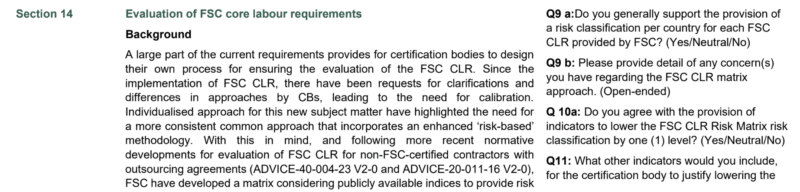
- Q9a – Yes
- Q9b – No concerns
- Q10a – No
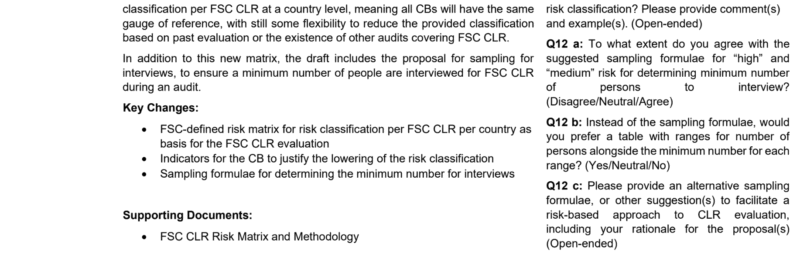
- Q11 – There is no reason to lower the risk classification other than the reason defined in 14.3.1. 14.3.2 simply adds complexity, without creating much gain. Additionally, what defines a “third party”? Could I decide that I’m a third party auditor, write a report, interview a few people, and get all of our CoC clients a reduction in risk? Is that the goal?
- Q12a – Agree
- Q12b – No
- Q12c – No response
Section 15
Background & questions

Chris’ comments
- Q13a – Neutral
- Q13b:
- 15.2 NOTE – the 15 month requirement does nothing to improve auditing, but simply exists to increase the number of NCRs issued. There is no need for this. If a certificate holder happens to be audited 23 months apart, that doesn’t really make a difference from 15 months.
- 15.5.2 – I would change “effective” to “required” as there is often a long rollout period to new changes in the standard.
- 15.5.3 This 3 month clause is just going to increase NCRs without adding any robustness to the standard. I suggest keeping the declaration but removing the 3 month notification requirement.
Section 16
Background & questions


Chris’ comments
- Q14a – Agree
- Q14b – 16.2.a.iii – The use of the word “may” is very important here, as having three sites with the same issue in a group or multisite of hundreds of sites is not a breakdown of the central office. It’s bad luck and/or human nature to err. I am not sure if this should be more explicitly defined, or is ok as is, but it’s an important point.
Sections 17 & 18
No major changes in these sections.
Section 19
No major changes in this section. Terminology aligned with FSC-PRO-60-006b.
Annex 1
Key changes in the evaluation report (no questions):
- Total number of workers (Section 1)
- Evaluation method (Section 3)
- If a derogation has been used for the audit (Section 3)
Annexes 2-4
No major changes in these sections.
Annex 5
Background & questions
Chris’ comments
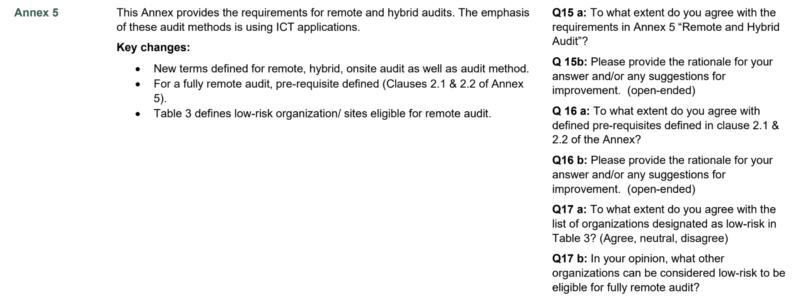
- 15a – Agree
- 15b – I would like to see remote auditing expanded, but this is a good start.
- 16a – Agree
- 16b – No response
- 17a – I would like to see this expanded to include any situation where the requirements of 2.1 are met.
- 17b – All organizations should be eligible if clause 2.1 is met. There should be a risk matrix for establishing how clause 2.1 is being met, based on the size and complexity of the organization.
Annex 6
Background & questions


Chris’ comments
- 18a – Agree
- 18b – No response
- 19a – Agree
- 19b – No response
In summary
The ultimate goal of the proposed revisions to the FSC CoC Standards is to achieve a delicate yet important balance between the integrity of the system and a streamlined approach.
- This post provides Chris’ review and comments for the proposed revisions for FSC-STD-20-011 only.
- If you’re interested in his review and comments for FSC-STD-40-004, check out our first post in the FSC CoC Consultation series.
- FSC members and stakeholders can provide feedback on the proposed revisions via the FSC Consultation Platform between now and January 25, 2026.
We hope this review proves helpful to you as you consider how you feel about the proposed revisions to the FSC CoC Standards. If you have any questions, feel free to reach out to the American Green team.
Featured image credit: Olena Bohovyk on Unsplash
